Wedding Planning
Wedding Budget Breakdown: Where the Money Actually Goes
A realistic wedding budget breakdown by category, with the percentages planners actually use, the traps that blow budgets, and the line items almost everyone forgets.
Colara · July 23, 2026
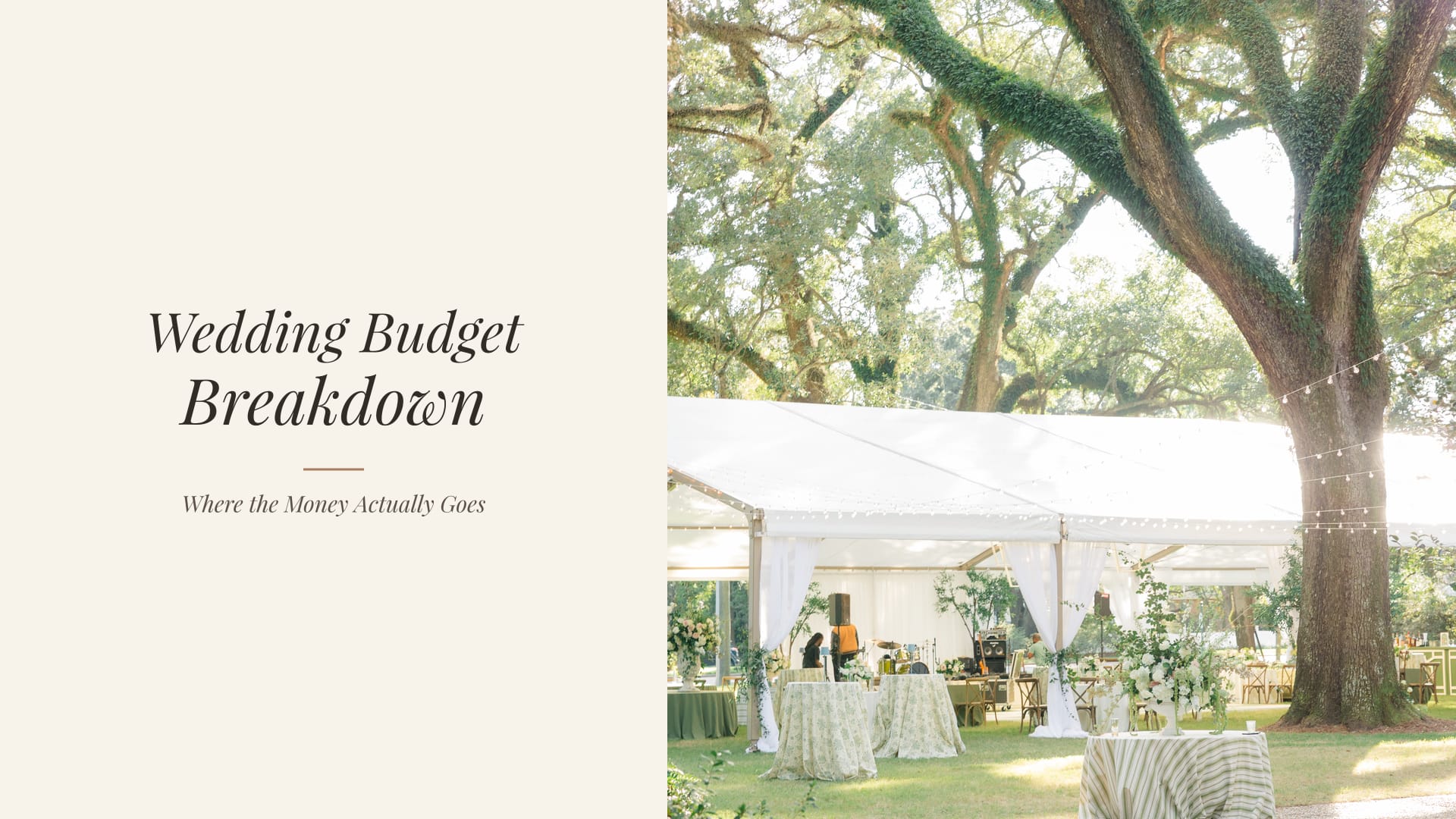
Every wedding budget conversation starts the same way. A couple has a number in their head, a venue tour on the calendar, and no idea whether $30,000 is generous or tight. The honest answer: it depends almost entirely on guest count and city, but the way the money divides up is surprisingly consistent from wedding to wedding.
This is the breakdown professional planners actually use, category by category, with the traps that blow budgets and the line items almost everyone forgets.
The short version
Recent industry surveys put the average U.S. wedding at roughly $33,000 to $36,000, with most couples landing somewhere between $15,000 and $50,000. Wherever your number falls, a classic full wedding usually divides up like this:
| Category | Share of budget | On a $30,000 budget |
|---|---|---|
| Venue | 23% | $6,900 |
| Catering and cake | 21% | $6,300 |
| Photography and video | 12% | $3,600 |
| Planner or coordinator | 8% | $2,400 |
| Flowers | 8% | $2,400 |
| Attire and beauty | 8% | $2,400 |
| Music | 6% | $1,800 |
| Stationery, transport, rings, tips | 14% | $4,200 |
If you want these percentages applied to your own number, with every line adjustable, our free wedding budget calculator does exactly that. No account, no email required to see your breakdown.
Reception first, everything else second
Venue plus food and drink typically absorbs 40 to 45 percent of the total budget. That single fact should drive your booking order: lock the venue and catering first, because until you do, you genuinely do not know how much is left for photography, flowers, and music.
Couples who book in the other order, photographer first, then florist, then venue, routinely end up either over budget or negotiating down the vendors they were most excited about. Nothing else in the budget moves the way the reception does.
Guest count is the whole game
Almost every line scales with guest count: catering is priced per plate, rentals per seat, stationery per household, favors per person, and larger guest counts push you into larger (more expensive) venues. Cutting 20 guests from a 120-person wedding often saves more than eliminating an entire vendor category.
Before you set category budgets, settle the guest list range. A budget built for 100 guests does not survive contact with a 150-person list.
Where couples consistently under-budget
Ask any planner and you will hear the same handful of lines:
- Tips and service charges. Catering service charges of 20 to 25 percent are often not in the quoted per-plate price, and vendor tips can add $1,000 or more.
- Alterations. The dress budget usually covers the dress. Alterations commonly run $300 to $800 on top.
- Day-of extras. Vendor meals, welcome bags, marriage license, overtime fees when the party runs long.
- Postage. Mailing invitations and RSVPs for 100 households is a real line item, especially with anything oversized.
A good rule: hold 5 percent of your total as a buffer and pretend it does not exist until the final month.
Where you can safely spend less
The categories with the widest quality-per-dollar range are flowers, stationery, and favors. Repurposing ceremony arrangements at the reception, going digital for save-the-dates, and skipping favors entirely are the classic moves, and guests genuinely do not notice.
The categories where cutting tends to hurt: photography and coordination. The photos are the only part of the day you keep, and a coordinator is the difference between you enjoying the timeline and you running it.
How planners use a breakdown like this
Professional planners use percentage breakdowns in the first consultation: enter the couple's number, walk through the categories together, and set expectations before any contracts are signed. It turns "we want everything" into an ordered list of priorities in about twenty minutes.
That is exactly the workflow our calculator was built for. Enter a budget, pick the closest wedding style, adjust any line, and print or save the result. And when you start booking vendors, a free Colara account picks up where the calculator leaves off: every category becomes a tracked budget item with vendors, payment schedules, and due-date reminders.
Try the free wedding budget calculator →
FAQ
What percentage of a wedding budget should go to the venue?
Around 23 percent for the venue itself. Combined with catering, the reception as a whole usually takes 40 to 45 percent of the total.
What is a realistic wedding budget for 100 guests?
Most 100-guest weddings land between $20,000 and $40,000 depending on the market. In major metros the same wedding can run well past $50,000.
How do I stick to a wedding budget?
Set the breakdown before booking anything, lock venue and catering first, keep a 5 percent buffer, and track every payment against its category as you book. A spreadsheet works; a purpose-built tracker with payment reminders works better.
Is 12 percent enough for wedding photography?
It is the standard starting point. If photos are your top priority, it is common to pull that up to 15 percent or more and trim flowers or stationery to compensate.