Wedding Planning
I Created My Wedding Timeline in 30 Seconds Instead of 3 Hours
96% of couples experience wedding planning stress. Timeline creation is one of the biggest pain points. Here is how a tool built from hundreds of real weddings generates a complete, professional timeline in 30 seconds flat.
Colara Team · March 5, 2026
I got married 17 years ago.
I had no clue how to build a wedding timeline. First look timing? Sunset calculations? Travel buffer between venues? I trusted my photographer to figure it all out.
That was the only option I had.
Now I'm a wedding photographer. I've worked hundreds of weddings. I've built hundreds of timelines for brides who are staring at the same overwhelming question I faced: What time should we do what?
And here's what I've learned.
The timeline creation process is broken. Chaotic. Stressful beyond belief.
The Timeline Paralysis That Stops Brides Dead
There are so many nuances to a wedding day that most brides don't even know exist.
Is there going to be a first look? When is sunset? Did we allow enough time for the wedding party? Did we account for travel between ceremony and reception? What about hair and makeup wrap time?
Did we forget something critical?
According to research, 96% of couples experience wedding planning stress. The platform Zola joked that "the other 4% lied."
That's not a cute statistic. That's reality.
Timeline creation is one of the things brides struggle with most. I'm starting to see this pattern everywhere — brides who feel completely paralyzed by the variables they can't control or predict.
What Goes Wrong When You Wait on Vendors
Here's how the traditional process works.
The makeup artist needs to know when everyone needs to be wrapped up. So the bride asks the photographer for a timeline. The photographer works on it and sends it to the planner. The planner makes tweaks and sends it back to the photographer.
Then — finally — the bride has something to work with.
It's a round-robin of back-and-forth communication. Multiple professionals. Multiple schedules. Multiple opinions about how much time things actually take.
I like to send brides a draft timeline. But I also don't want to send something when the planner hasn't signed off on it yet. So we create this waiting game where the bride sits in limbo.
And for DIY brides?
They're Googling "wedding day timeline template" and hoping a generic spreadsheet accounts for their unique situation.
Spoiler: It doesn't.
Why Generic Wedding Timeline Templates Fail
Standard templates are just that. Standard.
They can't possibly account for all the variables that make your wedding different from every other wedding. They don't know if you're doing a first look. They don't know when sunset happens on your specific date. They don't know how big your wedding party is or how long your ceremony runs.
Research shows that 79% of brides report planning everything themselves without assistance from professionals. And 40% admitted feeling overwhelmed and needing more support.
That gap between needing help and getting help? That's where timeline chaos lives.
I used to think timeline creation required human intuition. Professional experience. Years of knowing how weddings actually flow.
Then I tested something different.
What Happens When You Generate a Wedding Timeline in 30 Seconds
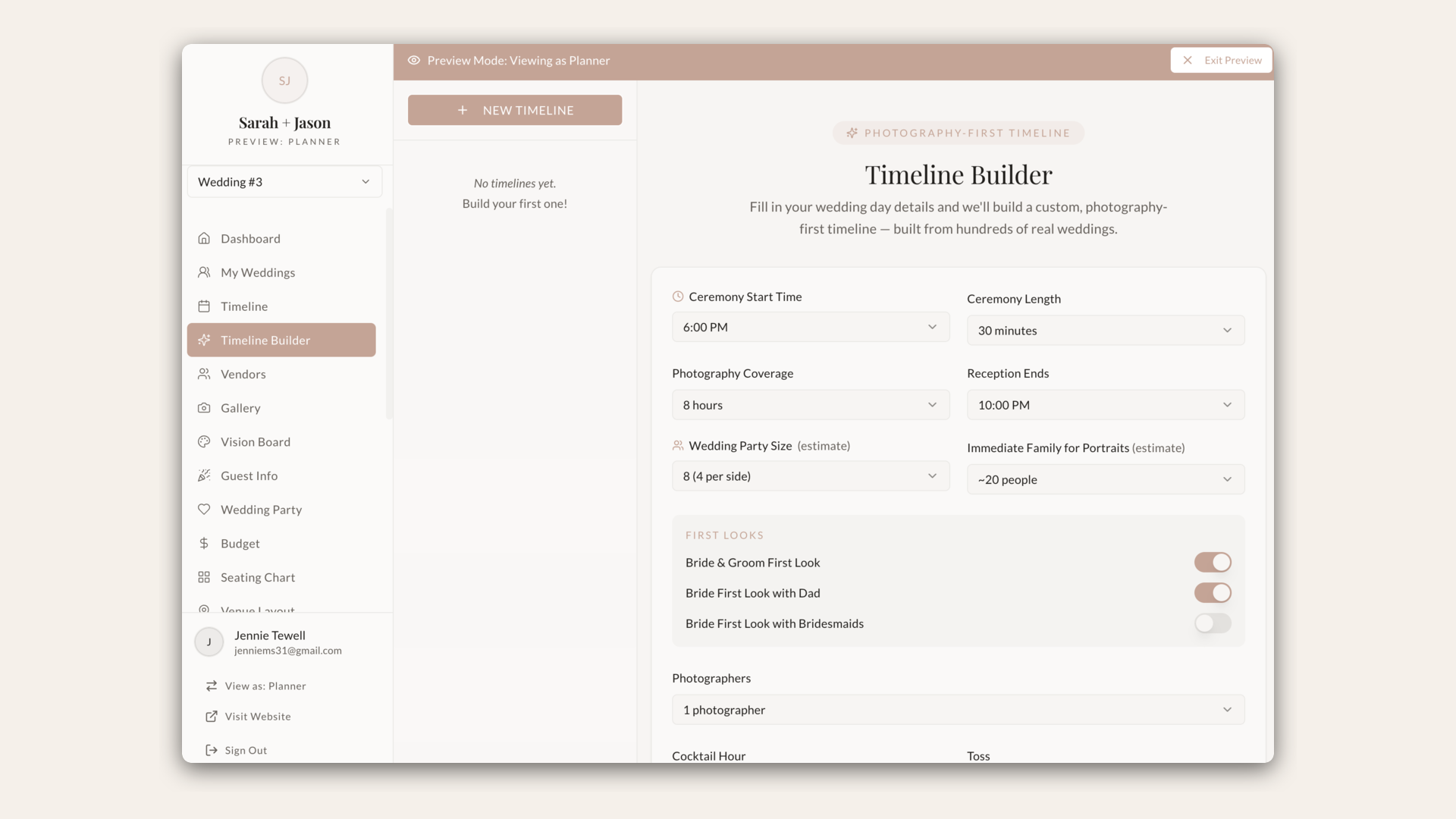
I built Colara's timeline generator using formulas I've refined over hundreds of weddings.
Not guesses. Not approximations. Actual math.
Here's what it needs from you:
- Your ceremony time
- Sunset time on your wedding date
- Whether you're doing a first look
- How many people are in your wedding party
- How long your ceremony runs
- When your photographer arrives
- How many hours of coverage you have
That's it.
You input those variables. You hit generate. Thirty seconds later, you have a complete timeline that accounts for everything a wedding professional would build manually.
It's not a template. It's building the timeline individually for your specific scenario.
The Wedding Day Calculations You'd Never Think About
Let's say your ceremony is at 4pm. Sunset is at 7pm. You chose no first look because you want that emotional aisle moment.
Here's what Colara calculates automatically:
All your formal photos happen after the ceremony. We'll fit in individual photos before the ceremony — bride with bridesmaids, bride with family, same for the groom. But the bulk of your portraits need to happen post-ceremony.
If those post-ceremony photos happen close to sunset, they become your sunset portraits. Perfect.
But if sunset happens more than 60 minutes after we finish those formal photos? The generator schedules additional portrait time later in the evening during your reception. Not randomly — it places them between big reception moments so they don't break the flow of your celebration.
You'd never think about that timing on your own.
Professional wedding photographers emphasize that "almost every single wedding day has something that runs behind schedule." Whether it's hair and makeup taking longer or shuttles getting stuck in traffic, buffer time isn't optional.
The generator builds that in automatically.
Where I Learned These Timeline Lessons the Hard Way
There have been plenty of weddings where there wasn't enough buffer time. Not enough time scheduled for portraits. Things ran late.
We can only do what we're capable of doing in the time we have.
I never insist a bride stick to my timeline. They can adjust it however they want. But brides who aren't in the wedding world week in and week out just don't know how much time is actually needed.
It's always disappointing when I know what we could have captured photo-wise if we'd had enough time. Or if the timeline had been followed.
Those moments taught me something crucial: The timeline isn't just a schedule. It's the framework that makes everything else possible.
According to The Knot 2024 Real Weddings Study, couples who created detailed timelines reported 30% fewer last-minute crises compared to those who "winged it."
That's massive.
What Brides Say When They See Their Generated Timeline
I've tested hundreds of generated timelines.
Every single time, it gives me exactly what I would create for a bride as a wedding professional. The timeline is complete. Brides don't have to think of anything. They can take it as-is and they're good to go.
When brides generate their timeline and see it for the first time, the response is usually the same.
"Oh. I would have never thought of that on my own."
The completeness surprises them. The level of detail. The way it accounts for things they didn't even know they needed to account for.
From Timeline to Wedding Command Center
Here's where it gets really interesting.
Once you have that complete timeline, you can send it directly to your vendors. Your wedding planner. Your photographer. Your makeup artist.
Everyone gets on the same page instantly.
No more round-robin emails. No more "Did you see the updated version?" confusion. No more wondering if your florist knows when setup needs to be complete.
Colara becomes your command center. You can build your wedding website, track guest RSVPs, create your seating chart, keep track of gifts, and monitor your budget — all in one place.
I'm starting to see a clear pattern: Brides who start with the timeline tool end up with less vendor miscommunication and fewer day-of surprises.
When everyone is working from the same strategic timeline from the beginning, the friction just disappears.
The One Place the Generator Struggles
I've tested this generator extensively. Hundreds of scenarios. Different ceremony times. Different coverage lengths. Different wedding party sizes.
There's only one area where it struggles: when there isn't enough time.
If you want everything — full getting-ready coverage, first look, wedding party photos, family formals, couple portraits, sunset photos, reception coverage — but you only give your photographer four hours of coverage?
You can't fit everything a wedding day needs into four hours. Unless it's a micro wedding, the math just doesn't work.
The generator will tell you that. It won't pretend you can squeeze ten pounds of photography into a five-pound timeline.
That honesty matters.
Why Starting With Your Timeline Changes Everything
When you have a strategic timeline first, every other wedding decision becomes easier.
You know when vendors need to arrive. You know when to schedule hair and makeup. You know if you have time for that second location you've been considering.
The timeline removes the guesswork.
Research shows couples spend an estimated 6–12 hours per week on wedding planning. That's massive. That's a part-time job.
Getting those 3 hours back from timeline creation? That's time you can spend on things that actually matter to you.
And once your timeline is set, don't forget to plan your family photo groupings — it's the other piece that photographers wish every couple would handle before the wedding day.
Get Your Wedding Timeline Now
Input your wedding details. Hit generate. See what 30 seconds of automation can do for your planning sanity. Then share it with your vendors and keep everyone aligned.
Related Wedding Planning Resources
- Free Family Photo Checklist Generator — Plan every grouping before the big day
- What Your Photographer Wishes You Knew About Family Photos — 7 tips to make family formals painless
- More Wedding Planning Tips — Browse all articles from the Colara blog
Stop staring at blank spreadsheets wondering if you forgot something critical. Start with a strategic timeline built by someone who's done this hundreds of times.