For Planners
Best Wedding Planner Software: 6 Professional Tools Compared (2026)
A professional planner's guide to wedding planning software in 2026: Aisle Planner, Planning Pod, HoneyBook, Dubsado, Timeline Genius, and Colara, honestly compared.
Colara · July 23, 2026

Quick answer: the best wedding planner software depends on the handoff you need to fix. Booking-first businesses should prioritize CRM and automation. Design-heavy teams need layouts and visual planning. Logistics-heavy planners need timelines, vendor coordination, and a usable wedding-day view. If you are still choosing, start with the workflow rather than the longest feature list.
Wedding planner software compared at a glance
| Best fit | Start with | What to verify |
|---|---|---|
| Free client management | Free CRM for wedding planners | Lead limits, contracts, invoices, client access, and payment fees |
| Planner-first all-in-one system | Wedding software comparisons | Timelines, layouts, guests, budgets, vendors, and day-of access |
| Deep business automation | General-purpose CRM | Setup time and which wedding-specific tools remain separate |
| Timeline-only improvement | Timeline software comparison | First-draft speed, vendor views, reminders, and version control |
Use a real wedding as the buying test
Create one inquiry, proposal, contract, invoice, client portal, questionnaire, timeline, and final vendor handoff. Count every place the names, date, venue, and schedule must be entered again. That test exposes the difference between a feature that exists and a workflow that actually connects.
If client management is the first bottleneck, use the eight-stage wedding CRM pipeline and the CRM setup guide before configuring automation. If the current system is a spreadsheet, the CRM-versus-spreadsheet decision guide shows when switching is worth the effort.
Search for wedding planning software and most of what ranks is written for brides: checklist apps, registry sites, inspiration boards. Useful, and useless to you. A professional planner running fifteen weddings needs software for a business where every project has forty vendors, three hundred guests, a six-figure budget that is not yours, and a client who texts. That category is smaller and stranger than the consumer one, and the honest map of it looks like this in 2026.
The uncomfortable truth about this category
Most "planner software" is one of two things wearing a costume. Either it is a generic client-management tool, great at invoices, no idea what a timeline is, or it is a couple-facing planning app with a professional tier bolted on. Genuinely planner-shaped platforms, tools that handle the client AND the wedding, are rare. That is why so many planners run a stack: a CRM for booking, Timeline Genius for schedules, a spreadsheet for budgets, AllSeated for floor plans, and email to hold it together. The stack works. It also means re-typing the same wedding into five systems.
The contenders, honestly
Colara
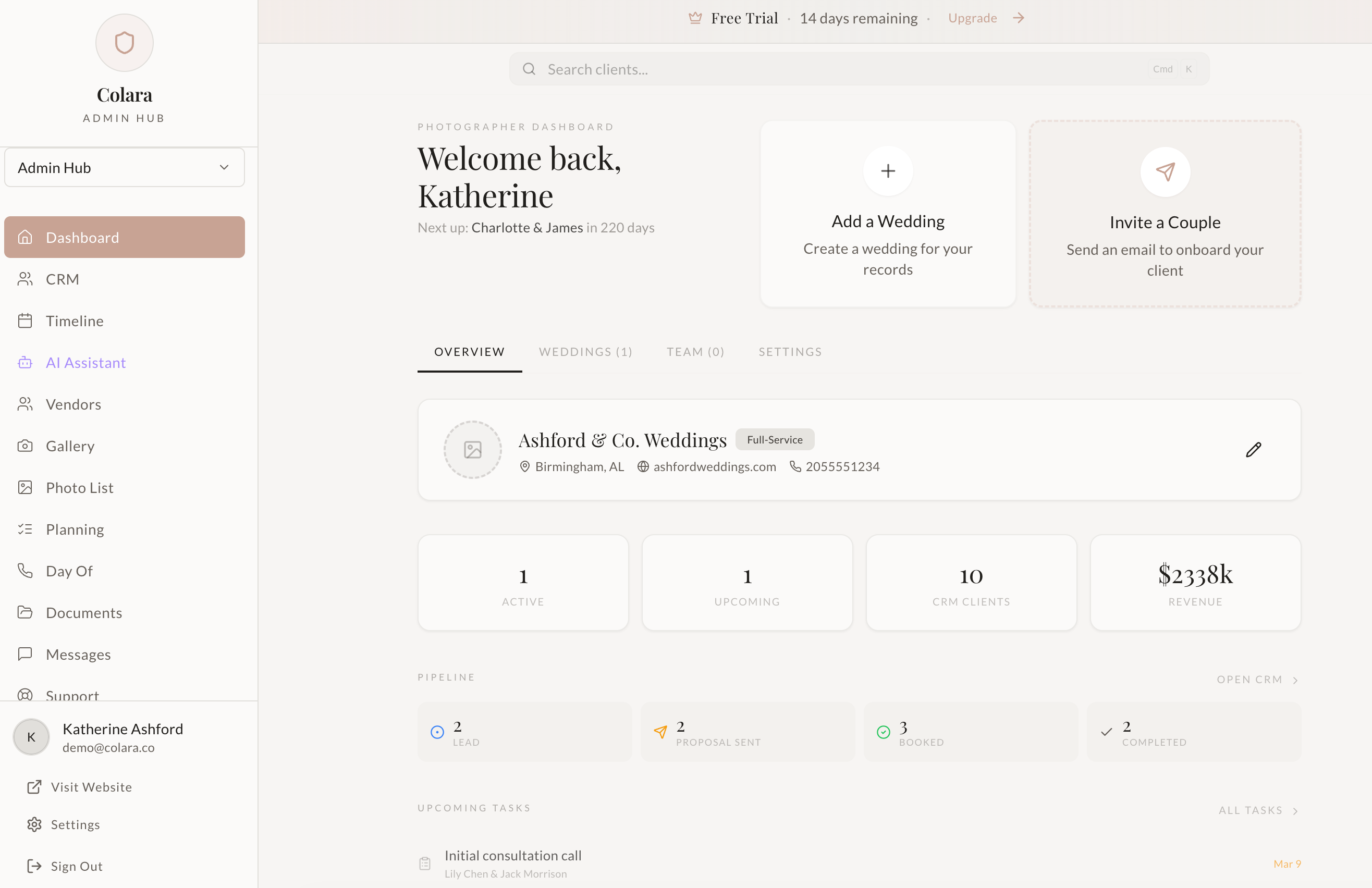
We build Colara, so weigh this accordingly. Colara's bet is that the stack should be one system: CRM with leads, proposals, contracts, and invoicing on one side, and the wedding itself on the other, AI-generated timelines, drag-and-drop floor plans and seating charts, budgets, guest lists, vendor coordination, and day-of SMS reminders. The piece planners notice first is the timeline: describe the day and the AI drafts the schedule in about 30 seconds, sunset and travel time included. The piece couples notice is that they get a real free workspace, not a read-only portal, so the version of the wedding you see is the version they see. Judge the timeline claim yourself with the free generator, or see the full timeline feature.
Aisle Planner
The long-standing name in planner-specific software, and the platform most working planners have either used or inherited from a mentor. Checklists, timelines, layouts, client portals, and a design studio, all genuinely built for planners. The critiques are consistent: the interface has aged, the timeline builder is manual, and development has slowed while the category moved. Still the most direct competitor to the do-it-in-one-place approach. See Colara vs Aisle Planner.
Planning Pod
Broad event-management software, weddings included but not the center. Its strength is breadth, floor plans, BEOs, registration, venue modules, which makes it a fit for planners who also run corporate events or manage venues. For a weddings-only planner it can feel like an office park where you use three rooms. See Colara vs Planning Pod.
HoneyBook and Dubsado
The CRMs planners actually use, covered honestly: excellent at booking, contracts, and getting paid, and blank on everything after the contract is signed. No timelines, no seating, no vendor day-of coordination. Planners on these tools run the stack described above. Both are covered in depth in our HoneyBook alternatives and Dubsado alternatives guides.
Timeline Genius
Not a platform, a point tool, but it belongs here because so many planner stacks include it. It builds and shares timelines, manually, and does nothing else. If you keep your current CRM and only want better schedules, it is the incremental option; our Timeline Genius alternatives guide covers when the increment stops being worth a separate subscription.
How to choose
Count your tabs on a real working day. If booking is your bottleneck, a polished CRM is the honest buy, and you will keep your spreadsheets. If you are a venue or corporate hybrid, Planning Pod's breadth earns its keep. If you are weddings-only and the re-typing is what burns you, the wedding entered in the CRM, again in the timeline tool, again in the seating app, then you want one of the two platforms where the wedding is the data model, Aisle Planner or Colara, and the differences between those two, AI versus manual timelines, couple workspace versus client portal, modern versus mature, are laid out in the comparison. And whichever direction you go, our free wedding budget calculator and planner pricing guide are useful regardless of platform.
Run your whole business in one place
Timelines, clients, proposals, invoices, contracts, and payments. Colara is built for wedding planners, $99/month after a free trial.
Frequently asked questions
What software do professional wedding planners use?
Most run a stack: HoneyBook or Dubsado for booking, Timeline Genius or spreadsheets for schedules, AllSeated or paper for floor plans. Planner-specific platforms like Colara and Aisle Planner consolidate that stack into one system built around the wedding.
What is the best wedding planning software for planners in 2026?
For weddings-only planners who want one platform, Colara (AI timelines, floor plans, CRM, couple workspace) or Aisle Planner (the established manual equivalent). For hybrid event businesses, Planning Pod. For booking-first planners happy with their spreadsheet stack, HoneyBook or Dubsado remain fine CRMs.
Is there wedding planning software with AI?
Colara generates complete wedding day timelines from a description in about 30 seconds, factoring in sunset time, travel between venues, and photography coverage, and includes an AI planning assistant. Most other tools in the category, including Aisle Planner and Timeline Genius, build timelines manually.
How much does wedding planner software cost?
Roughly $20 to $60 per month across the category depending on tier. Colara planner plans start at $49/mo with a 14-day free trial, with current pricing here. The fairer comparison is against your whole stack, a CRM plus a timeline tool plus a seating tool usually totals more than any single platform.